How to hand feed a lovebird chick, day one to weaning

Shada aviary team , Natore
Reviewed against the Nutricare label, batch 07·26
In this guide
Share
A lovebird chick pulled at two weeks needs about three weeks of hand feeding. Most of what goes wrong happens in the first four days, and almost all of it comes down to two numbers: the temperature of the formula and the state of the crop before the next feed.
Before the first feed
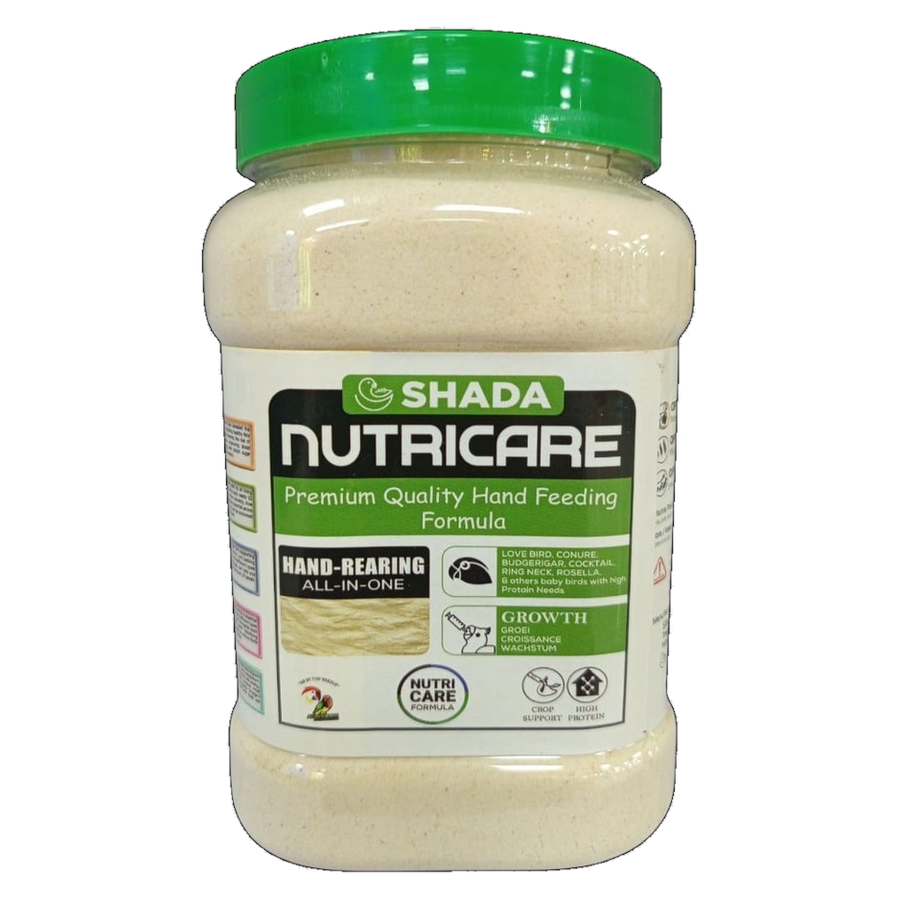
Set up before you pull the chick, not after. You need a brooder or a box that holds a steady warm temperature, a small digital scale that reads in grams, a syringe or a bent spoon, a thermometer for the formula, and a jar of hand feeding formula with the batch date still readable on the lid.
- Warmth first. A cold chick will not digest. Warm the chick before you warm the food.
- Weigh every morning before the first feed, and write it down. Weight is the only honest signal you have.
- One clean syringe per chick, rinsed in hot water between feeds. Formula left in the syringe sours in an hour in Bangladeshi heat.
Mixing the formula
Mix a fresh batch for every feed. Never keep formula from one feed to the next, and never reheat it. Use water that has been boiled and cooled to hand-warm, then adjust to the target temperature with the thermometer, not with your finger.
Consistency changes with age. For the first three days the mix should run off the spoon like a thin porridge. From day four, thicken it a little each day until, by the second week, it holds a soft peak. Follow the water-to-powder ratio printed on the jar and move within that range; a chick on a thin mix for too long fills up on water and stops gaining.
Feeds per day, by age
These are the routines breeders in our own room use. Treat them as a starting point and let the crop and the scale correct you.
| Age | Feeds | Mix | What to watch |
|---|---|---|---|
| Day 1 to 4 | Every 2 to 3 hours, including one feed late at night | Thin porridge | Crop empties fully before each feed |
| Day 5 to 14 | Every 3 to 4 hours, no night feed once weight climbs daily | Thickening | Steady daily gain; pin feathers appear |
| Week 3 | 4 feeds | Soft peak | Chick begins to refuse the last feed of the day |
| Week 4 to 5 | 3 feeds, then 2 | Soft peak | Pecking at soft food and Eggfood in the box |
| Weaning | 1 evening feed, then none | Weight dips slightly then holds. Normal. |
Reading the crop
The crop is the soft pouch at the base of the neck. After a feed it should be full and rounded, not tight like a drum. Before the next feed it should be nearly flat. If it is still half full when the next feed is due, skip the feed, keep the chick warm, and check again in an hour. Feeding on top of a slow crop is how sour crop starts.
Read Crop not emptying: what to do in the first hour for the three causes in the order to check them.
The two mistakes that lose chicks in week one
Weaning
From week four leave a shallow dish of soft food with a little Eggfood in the box during the day. The chick will play with it long before it eats it; that is the point. Drop the midday feed first, then the morning feed, and keep the evening feed until the chick refuses it two nights in a row. Expect a small weight dip at weaning and a recovery within the week. A dip that keeps going is a chick that is not eating, and the evening feed goes back on.
A weaned lovebird on Nutricare through this whole routine uses roughly one 100g jar per chick. Two chicks, two jars; a clutch of four, the 500g jar is the cheaper buy. See pack prices per kilo.
Questions we get on WhatsApp
Can I use a spoon instead of a syringe?
Yes. A small spoon with the sides bent inward is safer for a beginner because the chick sets the pace. It is slower and messier, and that is fine.
The chick will not open its beak. What now?
Check warmth first, then the crop. A cold chick or a full crop will not beg. Touch the side of the beak with the warm spoon; the feeding response usually follows.
How long does an open jar last?
Keep the lid tight, the jar dry and out of the sun, and use the dry scoop only. In the monsoon buy the size you will finish in the season rather than the biggest size.
Shada aviary team, Natore
Written by the breeders who rear the test clutches on every batch of Nutricare before it is sealed. Questions go to WhatsApp 01813-323535.
Share
Keep reading